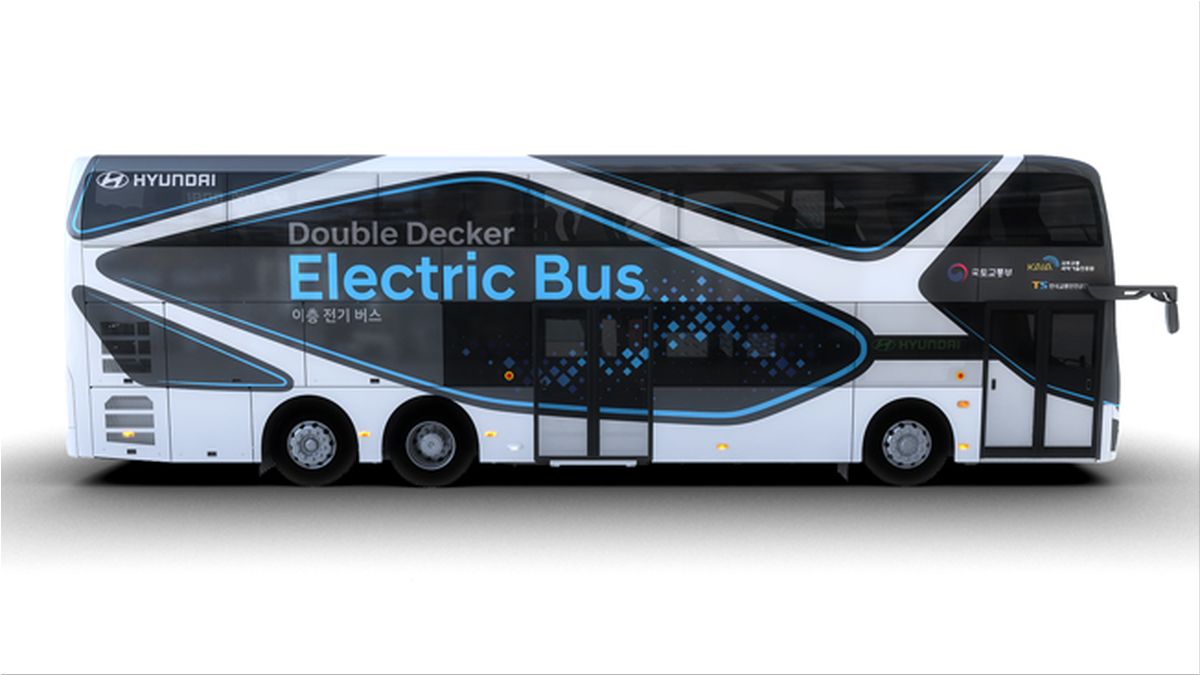
Hyundai Motor has introduced its first electrically powered double-decker bus. From when and in which countries the new 70-seater is to be sold, is not yet known.
The development of the vehicle began in 2017 and was funded by the South Korean Ministry of Land, Infrastructure and Transport.
The double-decker electric bus is powered by a 240 kW electric motor. In addition, a second small electric motor (used primarily for recuperation) is installed. It uses a 384 kWh, high-efficiency battery cooled by water, which according to the manufacturer is sufficient for a range of 300 kilometers. The estimated time of a full load is 72 minutes.

It has the capacity to transport up to 70 passengers that are divided into 11 seats on the first floor and 59 seats on the second floor. It offers a passenger capacity of up to 1.5 more than a regular bus.
The electric double-decker bus has a length of 12,990 mm and a height of 3,995 mm.
Passengers with mobility problems have two fixed wheelchairs, an automatic sliding ramp and the adaptation of the low floor.


It is equipped with advanced safety features:
dynamic vehicle control (VDC), which helps to identify the driving direction provided by the driver and to keep the vehicle under control;
assistant to avoid collisions (FCA) through the front camera of the vehicle, which helps detect an imminent collision and avoid impacts or minimize damage when braking autonomously;
and Lane Maintenance Assistance (LKA) helps prevent the accidental exit of lanes by detecting road markings.
"The double-decker electric bus is an environmentally friendly vehicle optimized for global eco-friendly trends," said ByoungWoo Hwang, Head of Commercial Vehicle Advanced Engineering team at Hyundai Motor. "This will not only ultimately improve the air quality, but also contribute greatly to easing commuting hour traffic congestion by accommodating more passengers."
The Jaguar I-Pace is the very first 100% electric model from the British manufacturer, a viable mid-range electric SUV. The I-Pace present sustainable sports car performance, innovative artificial intelligence (AI) technology and five-seat… Continue reading
Kia launches in Germany the presale of the new generation of Soul 100% electric car. The basic version Kia e-Soul will be available from 33,990 euros, the more powerful version from 37,790 euros. The e-Soul shows a modern, new design, is… Continue reading
Renault has officially unveiled the electric version of the city's Twingo hatchback, announcing that it will be available in late 2020. The model will be equipped with a 60 kW (82 hp) electric motor, which will receive energy… Continue reading
China is no longer just a producer of cheap cars, including electric cars. One of the most successful Chinese electric vehicle manufacturer is the NIO company, which offers premium electric cars. And the Hongqi brand goes even further in this… Continue reading