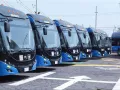
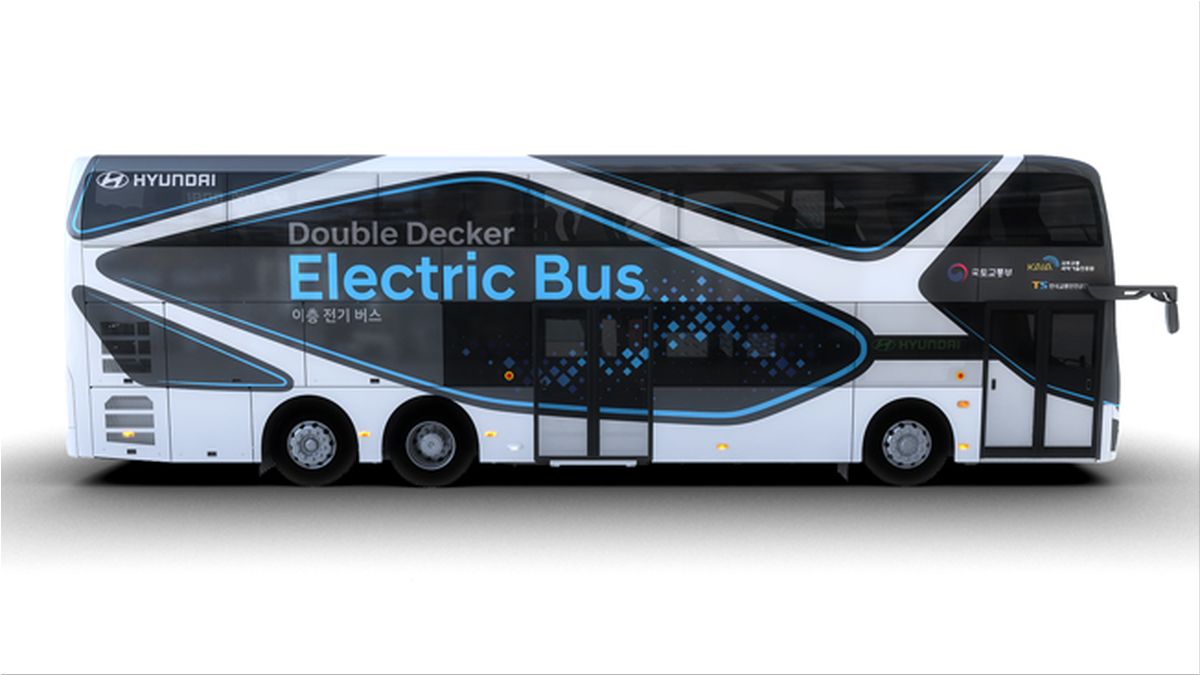
Hyundai Motor has introduced its first electrically powered double-decker bus. From when and in which countries the new 70-seater is to be sold, is not yet known.
The development of the vehicle began in 2017 and was funded by the South Korean Ministry of Land, Infrastructure and Transport.
The double-decker electric bus is powered by a 240 kW electric motor. In addition, a second small electric motor (used primarily for recuperation) is installed. It uses a 384 kWh, high-efficiency battery cooled by water, which according to the manufacturer is sufficient for a range of 300 kilometers. The estimated time of a full load is 72 minutes.

It has the capacity to transport up to 70 passengers that are divided into 11 seats on the first floor and 59 seats on the second floor. It offers a passenger capacity of up to 1.5 more than a regular bus.
The electric double-decker bus has a length of 12,990 mm and a height of 3,995 mm.
Passengers with mobility problems have two fixed wheelchairs, an automatic sliding ramp and the adaptation of the low floor.


It is equipped with advanced safety features:
dynamic vehicle control (VDC), which helps to identify the driving direction provided by the driver and to keep the vehicle under control;
assistant to avoid collisions (FCA) through the front camera of the vehicle, which helps detect an imminent collision and avoid impacts or minimize damage when braking autonomously;
and Lane Maintenance Assistance (LKA) helps prevent the accidental exit of lanes by detecting road markings.
"The double-decker electric bus is an environmentally friendly vehicle optimized for global eco-friendly trends," said ByoungWoo Hwang, Head of Commercial Vehicle Advanced Engineering team at Hyundai Motor. "This will not only ultimately improve the air quality, but also contribute greatly to easing commuting hour traffic congestion by accommodating more passengers."
E-VIA FLEX-E is a project co-funded by the European Commission that aims to install ultra-fast charging stations for electric cars in southern Europe. And more specifically, in Spain, France and Italy. The first phase of this… Continue reading

Irish Post is planning to buy 750 electric vehicles by 2022, of which 200 will hit the streets later this year. In addition to delivery vans, pedelecs (pedal electric cycle) are also on the shopping list. The background to this is that… Continue reading
Renault presents the experimental vehicle of a light commercial electric vehicle for urban traffic delivery: Renault EZ-FLEX. The EZ-FLEX comes with a purely electric drive and full network integration. A dozen models will soon go out to… Continue reading

The silence of electric cars bothers the European Union. The EU fears that risks may arise for the safety of those on the road, especially pedestrians, who might find themselves distracting or crossing the road when an electric car arrives. Therefore,… Continue reading