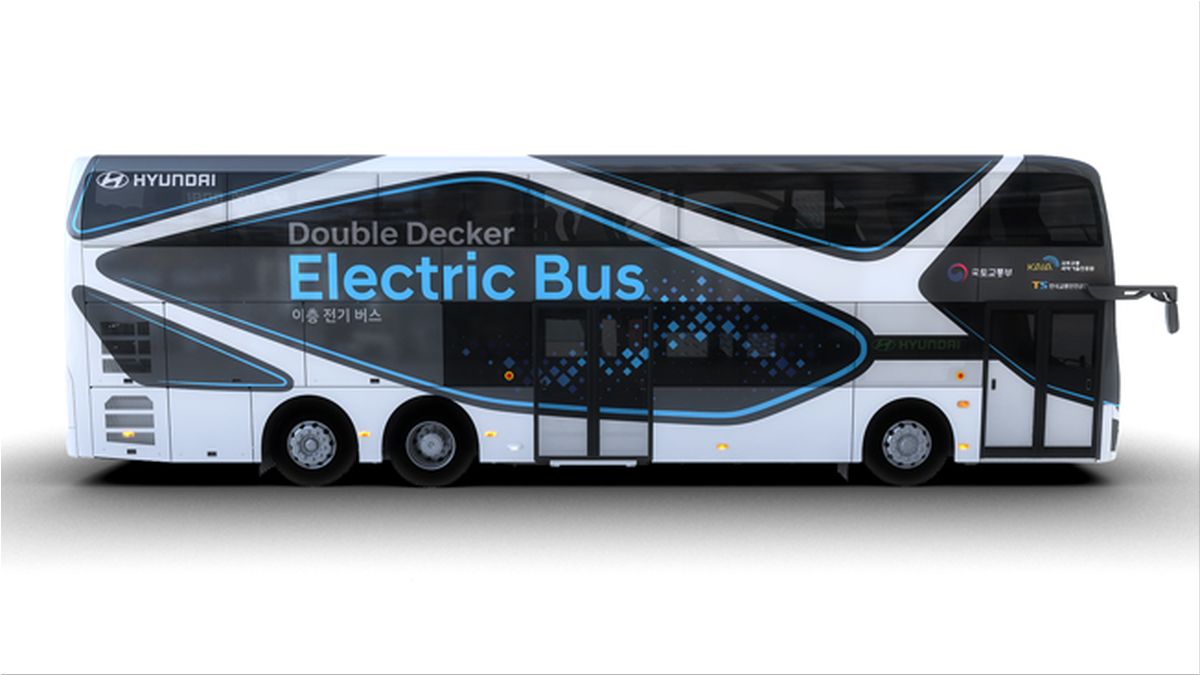
Hyundai Motor has introduced its first electrically powered double-decker bus. From when and in which countries the new 70-seater is to be sold, is not yet known.
The development of the vehicle began in 2017 and was funded by the South Korean Ministry of Land, Infrastructure and Transport.
The double-decker electric bus is powered by a 240 kW electric motor. In addition, a second small electric motor (used primarily for recuperation) is installed. It uses a 384 kWh, high-efficiency battery cooled by water, which according to the manufacturer is sufficient for a range of 300 kilometers. The estimated time of a full load is 72 minutes.

It has the capacity to transport up to 70 passengers that are divided into 11 seats on the first floor and 59 seats on the second floor. It offers a passenger capacity of up to 1.5 more than a regular bus.
The electric double-decker bus has a length of 12,990 mm and a height of 3,995 mm.
Passengers with mobility problems have two fixed wheelchairs, an automatic sliding ramp and the adaptation of the low floor.


It is equipped with advanced safety features:
dynamic vehicle control (VDC), which helps to identify the driving direction provided by the driver and to keep the vehicle under control;
assistant to avoid collisions (FCA) through the front camera of the vehicle, which helps detect an imminent collision and avoid impacts or minimize damage when braking autonomously;
and Lane Maintenance Assistance (LKA) helps prevent the accidental exit of lanes by detecting road markings.
"The double-decker electric bus is an environmentally friendly vehicle optimized for global eco-friendly trends," said ByoungWoo Hwang, Head of Commercial Vehicle Advanced Engineering team at Hyundai Motor. "This will not only ultimately improve the air quality, but also contribute greatly to easing commuting hour traffic congestion by accommodating more passengers."
McLaren announced that in 2019 will be the launching of a new generation of supercars that will be equipped with hybrid propulsion and autonomous technologies. Continue reading
Since 2014, 167 copies of the Tesla Model S are taxis at the Amsterdam Schiphol airport in the Netherlands. Now the taxi company BIOS-groep, has decided to replace its entire Model S fleet with the Tesla Model X. The decision… Continue reading

The Chinese company BYD has presented the K12A, an electric bus with a total length of 27 meters, which ensures that it is the "longest electric bus in the world". The K12A is the world's first 27-m pure… Continue reading
Volkswagen wants to install 36,000 charging stations for electric cars in Europe by 2025. The Volkswagen Group announces a significant increase in investments in charging infrastructure for electric cars with the intention of installing… Continue reading