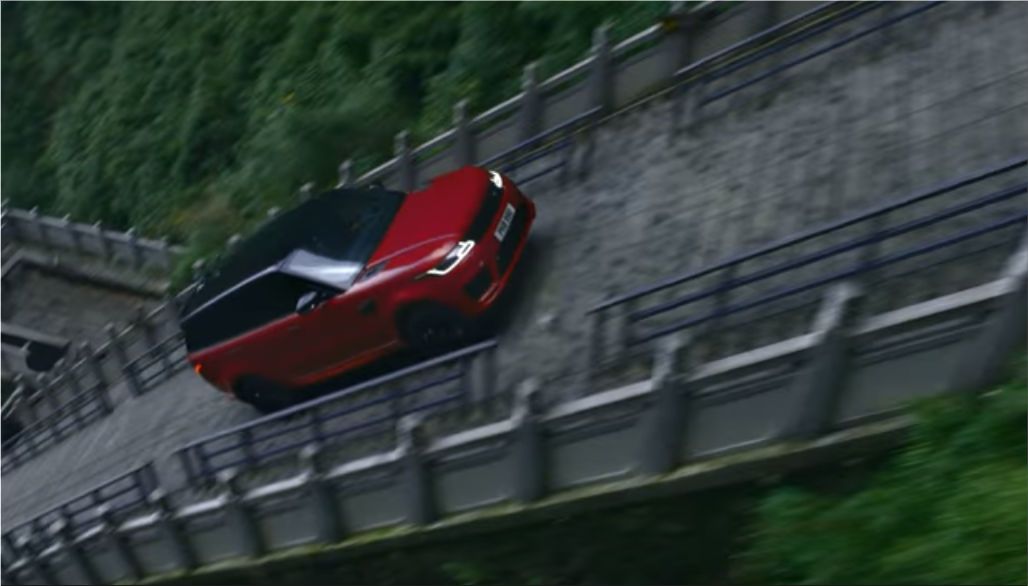
The Range Rover Sport PHEV overcomes the challenge of 11 kilometers in length and 1,279 meters of height which is accessed after 99 curves and a final staircase of 999 steps.
Range Rover Sport PHEV combines a 2.0 four-cylinder gasoline engine developing 300 hp (221 kW) with an electric motor of 85 kW (116 hp) powered by a 13.1 kWh lithium-ion battery. The gasoline engine is installed longitudinally and the electric motor is housed in the eight-speed automatic transmission located in the center of the vehicle, together with the onboard 7 kW battery charger. The two engines obtains 404 HP (297 kW) of power and a torque of 640 Nm.
The Range Rover Sport PHEV can go from 0 to 100 km / h in 6.7 seconds and reach a top speed of 220 km / h. In full-EV mode the hybrid car can drive for 31 miles completely zero emissions.

The driver Ho-Pin Tung said: “I’ve experienced Formula E, Formula 1 and won at the 24 Hours of Le Mans but this was without doubt one of the most demanding driving challenges I’ve ever faced. The Range Rover Sport PHEV performed brilliantly as it inspired real confidence on the mountain road and climbed the stairs up to Heaven’s Gate effortlessly.”


Phil Jones, Land Rover Experience expert, said: "This was the hardest Range Rover Sport challenge I’ve ever been involved with because, until we reached the top, we couldn’t categorically say we would succeed.
“By making it to the summit, we’ve proven the phenomenal capability of the Range Rover Sport plug-in hybrid like never before – with a genuine world first.”
via adruby.com
Two years ago, the Aachen-based electric car start-up e-Go Mobile was threatened with insolvency. New investors and a replaced management saved the company. The production of the e.Go Life electric microcar, which has been paused in the… Continue reading

The demand to drastically reduce vehicle emissions is being pushed ever further. As a result, Peugeot is one of the first manufacturers to offer an electric van with a hydrogen fuel cell in series production in the… Continue reading
A new electric era is starting with the Volvo EX90. Volvo has announced that beginning today, they will introduce a new all-electric vehicle annually. The goal is to be carbon neutral by 2040 and produce only electric cars by… Continue reading

Using heated surfaces inside an electric car as a heat source can cut the energy needed to heat the cabin by up to 13% and increase the range by 5%. This is shown in a big project funded by the EU, which Ford is now using to ensure that… Continue reading