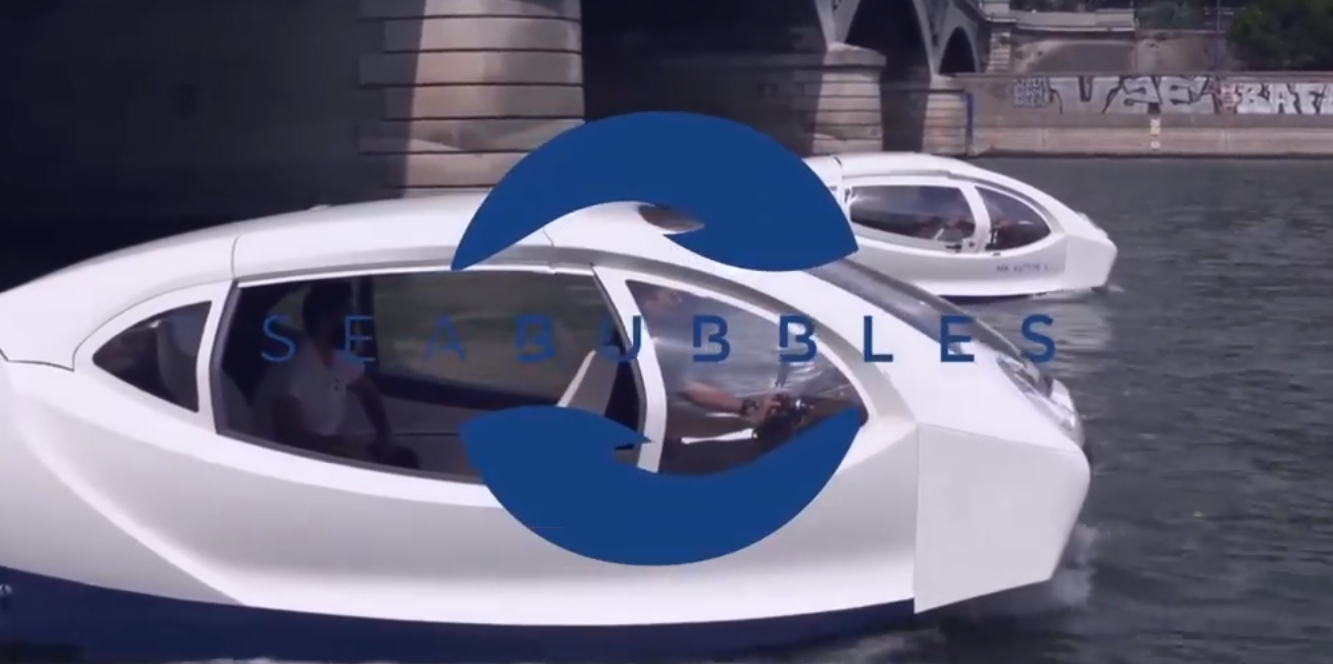
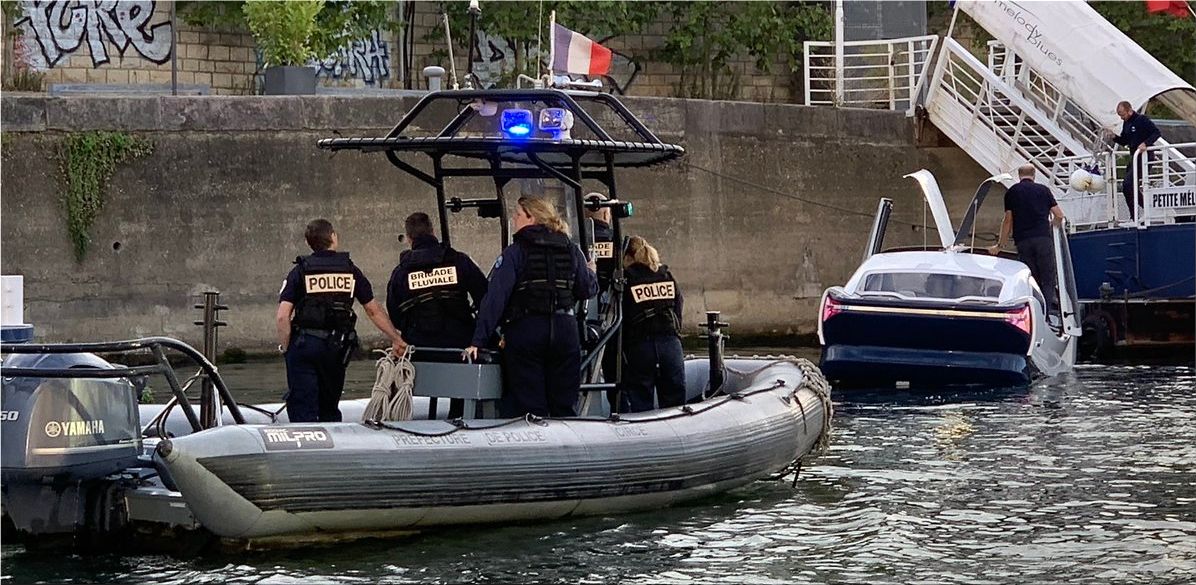
An electric water taxi developed by the French startup SeaBubbles was checked by police during a test drive on the Seine in Paris.
They assumed speeding but this is not true: While on the Seine is usually a speed limit of 12 km / h, there is an exception for the SeaBubbles for up to 30 km / h. I think maybe the water police wanted to take a closer look at the SeaBubbles.
The 100% electric vehicle "Bubbles", developed by French startup Seabubbles, produces “no noise, no waves and no pollution” thanks to an innovative design that makes it appear as though it is hovering above the water. River police interrupted the tests over concerns it was going too fast.
“Our vehicle has the right to go at 30km/h when normally the speed limit on the river is 12km/h,” SeaBubbles co-founder Anders Bringdal told The Independent. “So they just pulled us over to check our paperwork and make sure that all was in order.”
This strange bubble, 100% electric, rises above the water and only thin wings keep contact with the surface. Everything works only through electricity. "Zero-emission, zero noise, zero waves,"
Three years after the idea was born, twenty-first bubbles will finally be available for pre-order, priced at 140,000 euros.

Until a few months ago, Rivian was unknown to the general public. Headquartered in Michigan, the Michigan-based company was first established in 2009 but was not acknowledged until last November's Los Angeles Motor Show, when it introduced the… Continue reading

Xiaomi has formalized a revised and corrected version of its Mi Electric Scooter: the Pro version, officially presented today. Aesthetically, it has no significant differences compared to the non-Pro model: the design is minimalist,… Continue reading

Rosenbauer Australia and the ACT government, together with the ACT Emergency Services Agency plan to jointly develop a plug-in hybrid fire engine for service operations over the next two years. The PHEV fire truck based on the… Continue reading
The UK government has doubled funding for the installation of charging points on residential streets to £ 10 million - the equivalent of 11.75million euros. This could finance up to 3,600 new charging points across the country.… Continue reading