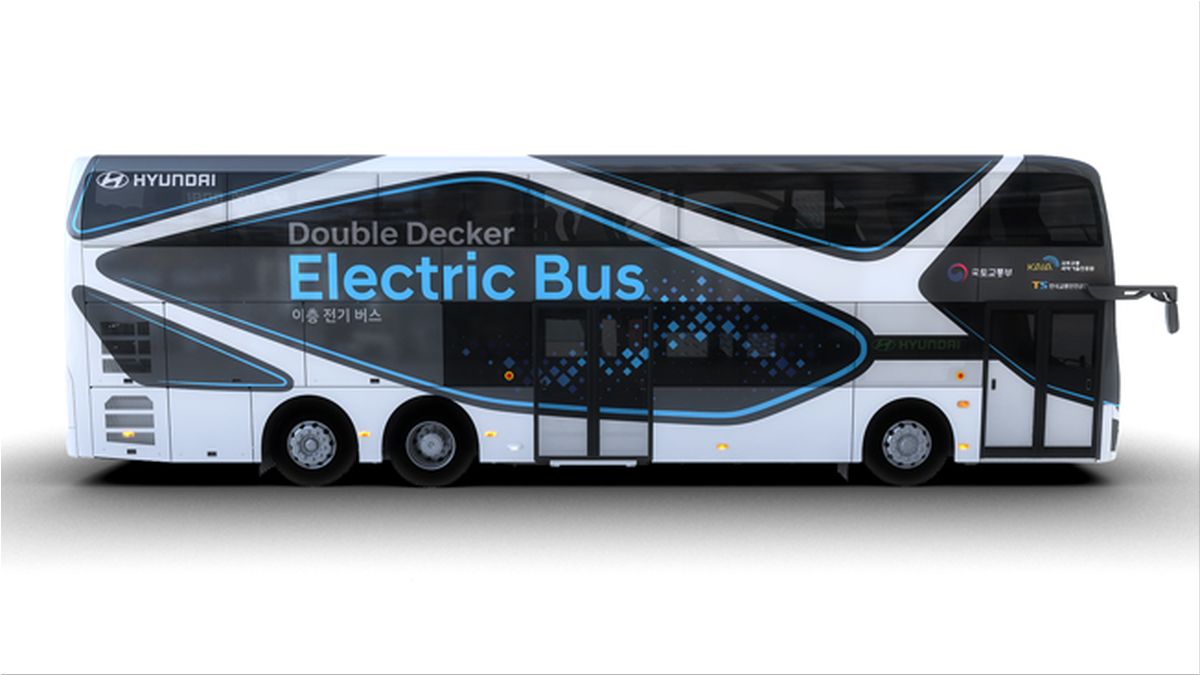
Hyundai Motor has introduced its first electrically powered double-decker bus. From when and in which countries the new 70-seater is to be sold, is not yet known.
The development of the vehicle began in 2017 and was funded by the South Korean Ministry of Land, Infrastructure and Transport.
The double-decker electric bus is powered by a 240 kW electric motor. In addition, a second small electric motor (used primarily for recuperation) is installed. It uses a 384 kWh, high-efficiency battery cooled by water, which according to the manufacturer is sufficient for a range of 300 kilometers. The estimated time of a full load is 72 minutes.

It has the capacity to transport up to 70 passengers that are divided into 11 seats on the first floor and 59 seats on the second floor. It offers a passenger capacity of up to 1.5 more than a regular bus.
The electric double-decker bus has a length of 12,990 mm and a height of 3,995 mm.
Passengers with mobility problems have two fixed wheelchairs, an automatic sliding ramp and the adaptation of the low floor.


It is equipped with advanced safety features:
dynamic vehicle control (VDC), which helps to identify the driving direction provided by the driver and to keep the vehicle under control;
assistant to avoid collisions (FCA) through the front camera of the vehicle, which helps detect an imminent collision and avoid impacts or minimize damage when braking autonomously;
and Lane Maintenance Assistance (LKA) helps prevent the accidental exit of lanes by detecting road markings.
"The double-decker electric bus is an environmentally friendly vehicle optimized for global eco-friendly trends," said ByoungWoo Hwang, Head of Commercial Vehicle Advanced Engineering team at Hyundai Motor. "This will not only ultimately improve the air quality, but also contribute greatly to easing commuting hour traffic congestion by accommodating more passengers."

Polestar pushes real-time navigation forward Polestar has become the first automaker to integrate Google Maps’ new Live Lane Guidance directly into a production vehicle. The feature debuts in the… Continue reading

Polestar has published the full carbon footprint of the Polestar 5, and the big story sits in the data. The company's new life cycle assessment pegs the Polestar 5 carbon footprint at… Continue reading
The 2026 Hyundai IONIQ 5 N now starts at $59,900, or $61,500 after its $1,600 destination charge. Hyundai cut MSRP by $6,300 while retaining 641 horsepower, 221 miles of EPA-estimated range, and its full track hardware package. It also adds… Continue reading
After presenting the new range of Sprinter vans at the beginning of the year, which already included an all-electric version, Mercedes-Benz has revealed all the details of its new electric van for urban… Continue reading