Electric Hunter

Main navigation

  • 100% EVs
  • News
  • Wheelers
  • Commercial
  • Hybrid
User account menu
  • Contact

Breadcrumb

  1. Home
  2. E.V. News
  3. Porsche Turns Old EV Batteries Into New Battery Cells

Porsche Turns Old EV Batteries Into New Battery Cells

Porsche Turns Old EV Batteries Into New Battery Cells

On September 17, 2026, Porsche and German recycler cylib announced test cells whose cathode active material comes entirely from recycled Porsche batteries. That is a real technical step, but it is still a pilot. No customer car uses these cells yet, and Porsche has not promised lower prices, longer range, or a production date.

What did Porsche achieve with recycled EV batteries?

Porsche recovered lithium, nickel, cobalt, and manganese from end-of-life high-voltage batteries, processed those metals into fresh cathode active material, and used it in new test cells. The recycled feedstock replaced newly mined versions of those four cathode ingredients. Porsche now tests the cells under operating conditions before it considers series production.

The wording deserves care. Porsche did not announce a battery pack made wholly from old packs. It announced cells whose cathode active material uses 100% recycled raw materials. That narrower claim still counts. Cathode material sets much of a cell's energy capacity, power behavior, cost, and resource demand.

The cells have reached a working-test phase, not a showroom. Porsche says early results support technical feasibility, with further findings due in the second half of 2026. The company has not released capacity retention, fast-charging, cycle-life, cold-weather, safety, or cost data.

That missing data is the line between an encouraging lab result and a bankable production process. Making one good batch proves chemistry. Making thousands of consistent batches at a competitive cost proves a business.

What is cathode active material?

Cathode active material stores and releases lithium ions on one side of a lithium-ion cell. In nickel-rich chemistry, it commonly contains lithium, nickel, cobalt, and manganese. Think of it as the chemically busy powder on the positive electrode, not the complete electrode, cell, module, or battery pack.

A cell also contains an anode, electrolyte, separator, copper and aluminum current collectors, binders, conductive additives, tabs, and a casing. A finished pack adds cooling hardware, wiring, sensors, controls, structural parts, and crash protection. Porsche's 100% figure does not cover all of those pieces.

How does Porsche's closed-loop battery process work?

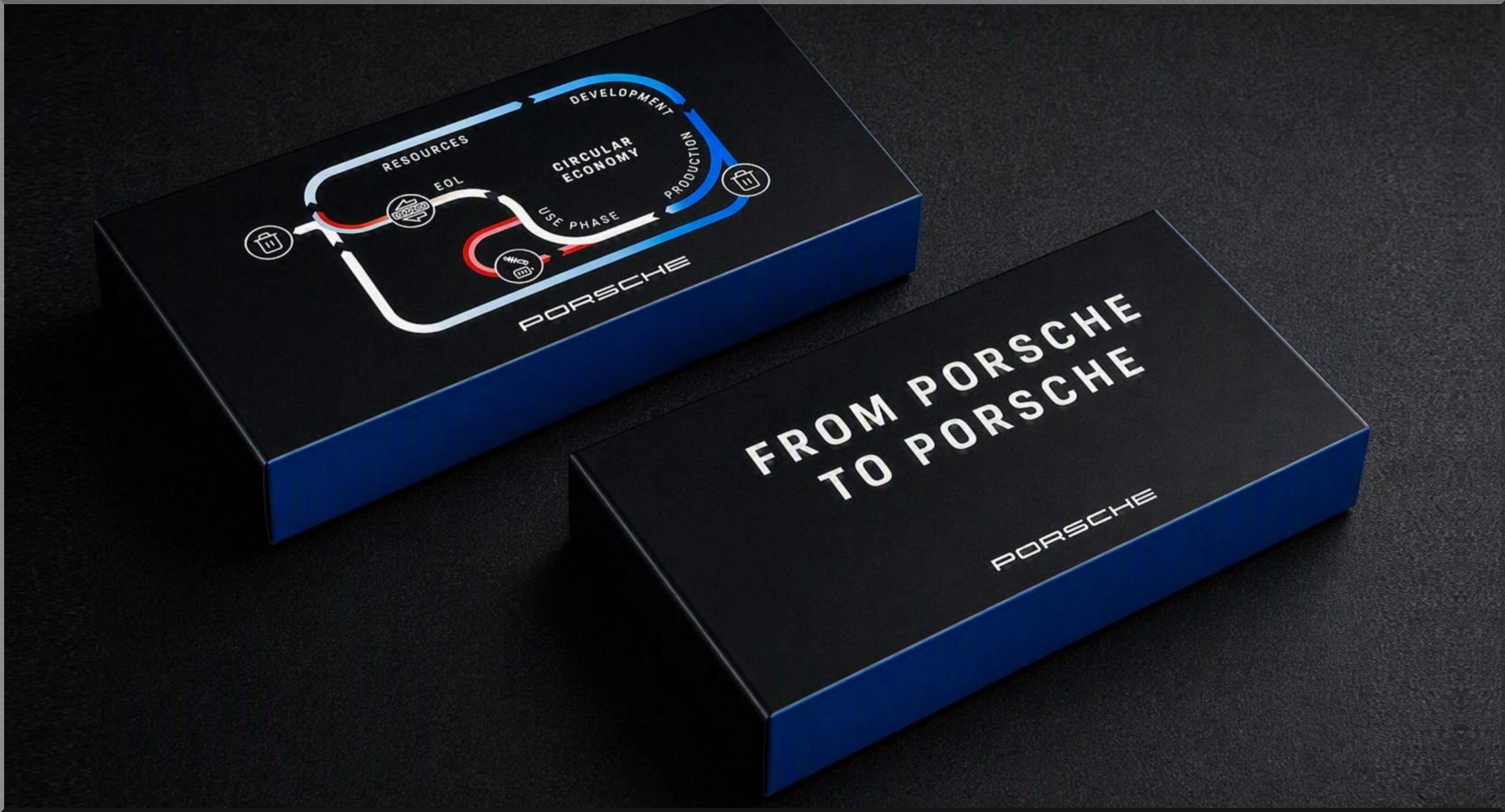
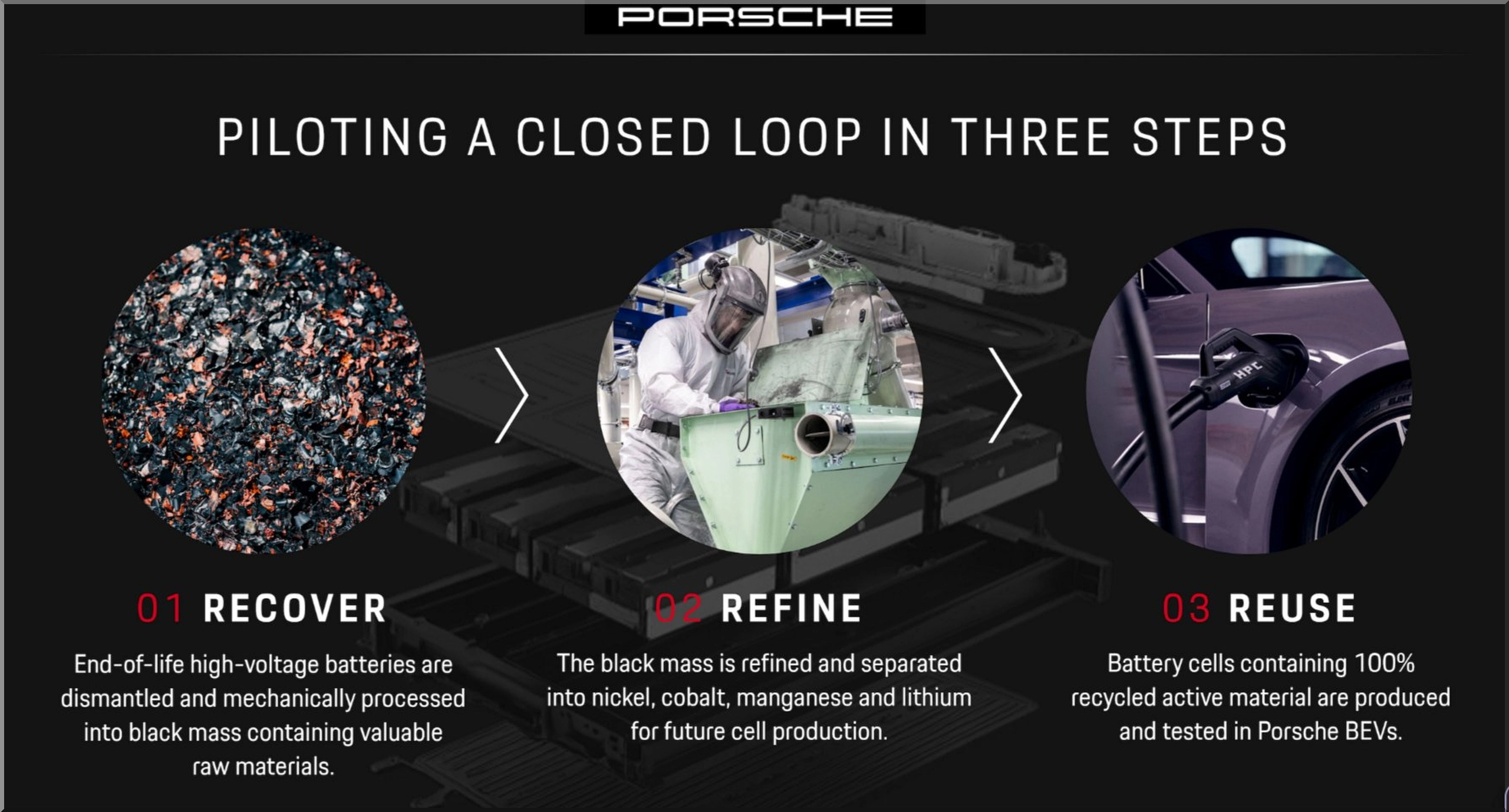
The pilot follows a six-stage loop: collect depleted Porsche packs, make them electrically safe, dismantle them, shred selected parts, recover metals from the resulting black mass, and rebuild those metals into cathode material for fresh cells. Each stage must protect purity, safety, traceability, and usable material yield.

  1. Collection: End-of-life high-voltage batteries enter the program through Porsche Centers in Germany.
  2. Discharging: Technicians remove stored electrical energy so crews can handle the pack safely.
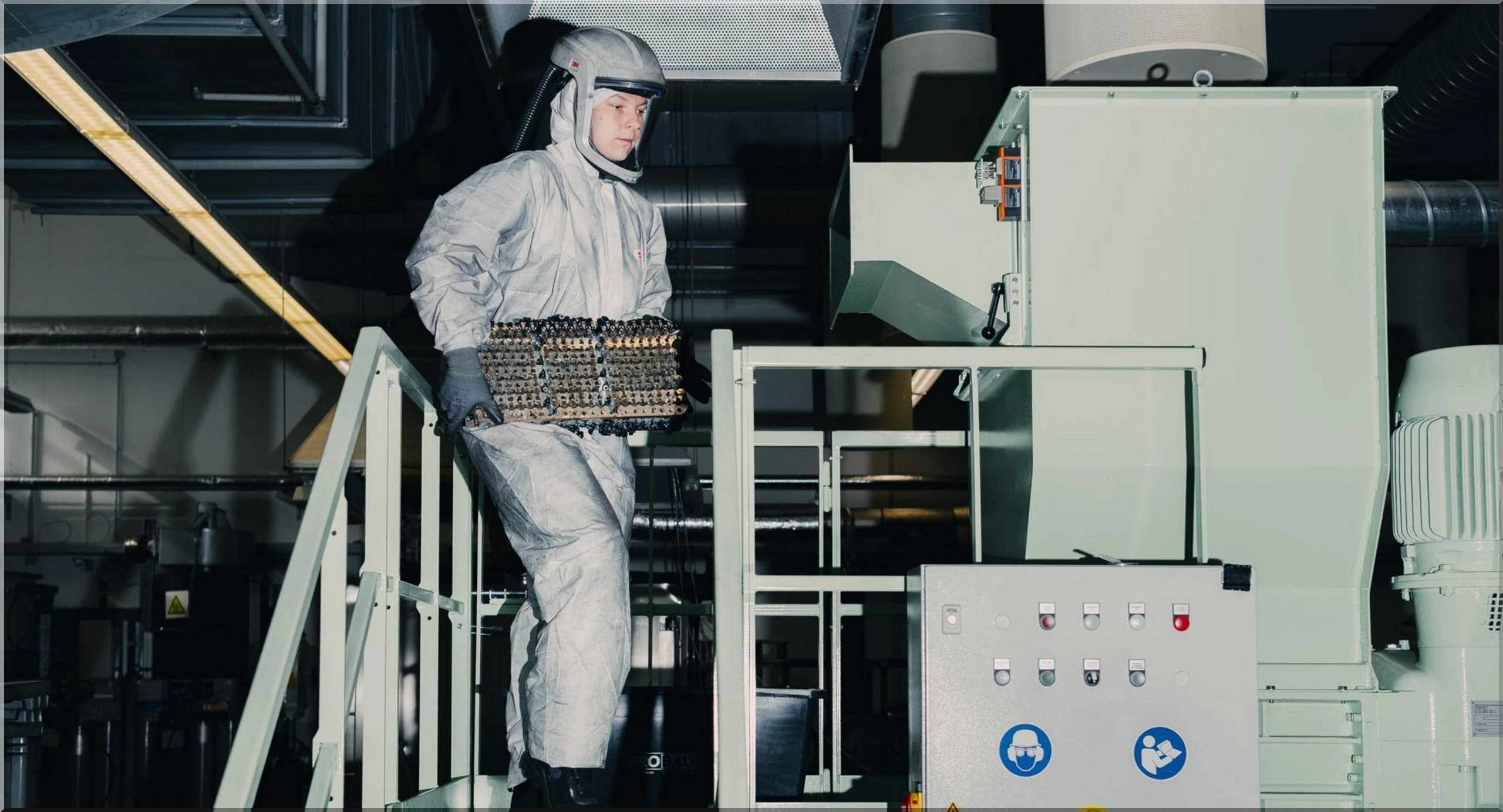
  3. Dismantling: Workers separate pack hardware and isolate the cell material destined for processing.
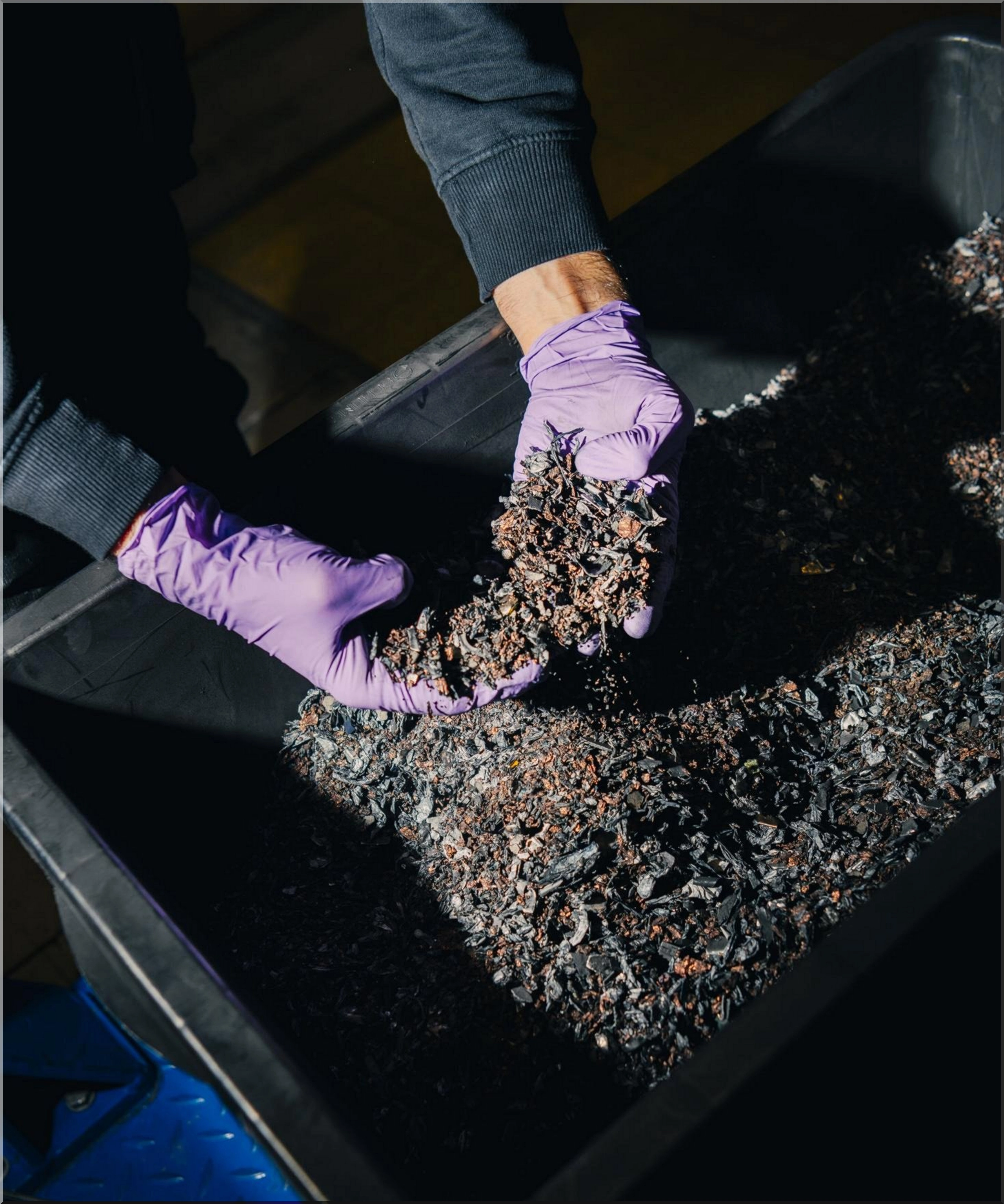
  4. Mechanical processing: Equipment shreds the battery material and produces a concentrated powder called black mass.
  5. Water-based recovery: cylib separates and refines lithium, nickel, cobalt, and manganese through its proprietary process.
  6. Cell production: Partners turn the recovered metals into new cathode active material and build test cells.

Black mass is not ready-to-use battery material. It is a mixed intermediate that still needs chemical separation, purification, and precise reprocessing. Tiny contaminants can hurt cell life, charging behavior, or safety. Battery-grade purity is where the clever recycling video meets the unforgiving factory specification.

cylib says its full process reaches 90% recycling efficiency and cuts the carbon footprint of recovered material by 80% versus primary extraction. It also says its operations use renewable electricity. Those figures describe cylib's process claims, not verified results for a future mass-produced Porsche pack.

Since May 2026, the partners have applied the recycling route to batteries collected through Porsche's German service network. A dedicated material account tracks the recovered resources. Porsche expects those credited materials to become available to the company and selected partners for battery-cell production from 2028.

What are the strongest pros and cons?

The main gain is technical: Porsche has shown that metals from its own retired batteries can return to new cathode material. The main limit is scale: the company has not published output, cost, yield by metal, or full test results. A closed loop only earns that name when it runs repeatedly at industrial volume.

Area Pro Con
Raw materials Recovers lithium, nickel, cobalt, and manganese Porsche has not disclosed metal-by-metal yield
Cell quality New test cells are working Full durability and safety results remain private
Carbon impact cylib reports lower emissions than primary extraction Porsche has not published a pack-level life-cycle study
Supply security Keeps valuable feedstock within Europe The present collection network covers Germany
Buyer cost Recovered metals may reduce exposure to commodity swings Porsche announced no vehicle-price saving

Our read is simple: this pilot solves a technical question, not the commercial one. Porsche and cylib have shown that recovered cathode metals can go back into a high-performance cell. They still need to prove repeatability, throughput, quality control, and cost when the incoming packs vary in age, chemistry, damage, and state of charge.
Image
Battery Cells

Will recycled cathode material make Porsche EVs cheaper?

Not soon, based on the information Porsche released. Recycling may cut exposure to imported raw materials and unstable commodity prices, but collection, hazardous-goods transport, disassembly, purification, cathode synthesis, testing, and certification all cost money. A pilot cell does not translate into a lower Porsche Taycan or Macan Electric sticker price.

For total cost of ownership, the near-term effect is close to zero. The project does not change charging costs, insurance, maintenance, range, repair pricing, depreciation, or warranty terms for current owners. A mature recycling market could support residual values by giving damaged or retired packs a clearer recovery value, but Porsche has published no buyer-facing estimate.

The smarter consumer question is not, 'Will this make my next Porsche cheap?' It is, 'Can this reduce supply risk and embedded emissions without weakening battery life or raising cost?' Porsche has answered only the first technical piece.

Why does this pilot carry weight in Europe?

Europe wants more battery materials recovered and reused inside its own industrial network. EU rules set minimum recycled-content shares for EV battery active materials from August 2031: 16% for cobalt, 6% for lithium, and 6% for nickel. Higher targets arrive in 2036, alongside tighter material-recovery goals.

Porsche's test cell goes much further within its cathode boundary, but readers should not compare the figures as if they measure the same thing. The EU targets apply by battery model, year, and manufacturing plant. Porsche's 100% figure describes the source of specific cathode ingredients in pilot cells. It does not prove future regulatory compliance.

For North American buyers, this remains a European project. Porsche identified German collection sites, European processing, and material availability from 2028. It announced no US battery-return program, US recycling partner, or North American vehicle application. That may change later, but the current facts stop at Europe's door.

Should an old EV battery go straight to recycling?

No. A battery that no longer suits a high-performance car may still serve in stationary storage. Repair, module reuse, and second-life use can preserve its remaining capacity before material recovery. Recycling should close the loop after useful service ends, not cut short a safe second life.

Porsche already offers a good example at its Leipzig plant. The company took 4,400 used Taycan modules from pre-series and test vehicles and built a 10-megawatt-hour storage system. It can deliver 5 megawatts, supports factory power management, and Porsche designed it for more than ten additional years of use.

That sequence makes practical sense:

  • Repair a pack when safe, economical work can return it to vehicle duty.
  • Reuse sound modules when the full pack no longer meets vehicle demands.
  • Repurpose capable modules for stationary storage with less punishing power needs.
  • Recycle the remaining material when another useful service no longer makes sense.

This order preserves the energy and labor already invested in the battery. It also delays shredding until the pack has delivered as much useful work as safety and economics allow.
Battery Cells

What should EV buyers watch next?

Buyers should watch for public test data, a production decision, annual processing capacity, actual recovery yield, and a named vehicle program. Those details will show if Porsche has built a scalable supply route or a polished pilot. Until then, read the announcement as credible progress with several hard gates still ahead.
Look for five proof points:

  • Cycle life: Do recycled-material cells retain capacity as well as cells made with primary metals?
  • Fast charging: Can they accept Porsche-level charging power without faster degradation?
  • Consistency: Can every batch meet tight purity and particle specifications?
  • Economics: Does the closed loop compete after transport, processing, and quality checks?
  • Scale: How many packs and gigawatt-hours can the network handle each year?

Pro-Tip: Read every recycling percentage carefully

Ask what the percentage measures. It may describe pack weight, process efficiency, recovery of one metal, or recycled content in one cell component. These figures answer different questions. A trustworthy claim names the boundary, chemistry, input source, test method, output purity, and production scale.

Image gallery:
Battery Cells

What is the practical verdict?

Porsche and cylib have cleared a meaningful technical gate: retired Porsche battery metals have returned to working cells as fully recycled cathode feedstock. The result deserves attention, not confetti. Production volume, durability, economics, and North American availability remain open. The next useful move is simple: publish the test data and name the first production program.

For shoppers, nothing changes today. Keep judging an EV by purchase price, insurance, real charging access, battery warranty, cold-weather range, repairability, and expected depreciation. For the industry, keep watching Porsche's 2028 material timeline. If the loop runs at scale, old packs may become useful supply assets instead of an expensive end-of-life problem.

Category

  • E.V. News

Brand

  • Porsche

Tags

  • Battery recycling
  • Porsche battery recycling
  • Porsche recycled battery cells
  • Recycled battery cells
  • Battery cells
  • 100% recycled cathode material
  • EV battery recycling process
  • EV battery recycling
  • EV battery life
  • End-of-life EV batteries
  • Recycled lithium battery materials
  • recycled materials
  • EV battery raw material recovery
  • Material recovery
  • Battery technology
  • Add new comment
  • 135 views
Profile picture for user electric cars
By electric cars, 18 September, 2026

Similar news

Audi e-tron electric SUV

The first all-electric Audi is available to pre-order

Audi e-tron electric SUV
  • Audi

  • Audi e-tron

Audi has opened the registrations for its first 100% electric car, a sports SUV that will be between Q5 and Q7 and whose launch will take place later this year. The new Audi e-tron electric SUV can now be pre-ordered in Spain. Audi has...

Innovative fuel cell solves the problem of energy storage

Innovative fuel cell solves the problem of energy storage

battery storage
  • fuel cells

The major problem of switching to renewable energy sources is the lack of available technologies for converting electricity derived from solar and wind energy into chemical fuel for long-term storage and in the opposite direction. ...

New Cadillac Optiq-V EV SUV Launches With 275-Mile Range and Super Cruise

New Cadillac Optiq-V EV SUV Launches With 275-Mile Range and Super Cruise

Cadillac Optiq-V
  • Cadillac

  • Cadillac Optiq-V

The 2026 Cadillac Optiq-V enters the EV space as the brand’s first compact electric SUV to wear the V-Series badge. It's also the first GM vehicle to offer a native Tesla NACS charging port, putting it in direct...

Polestar 4 and Google Maps

Google Maps Live Lane Guidance Debuts in Polestar 4: What Drivers Must Know

Polestar 4 and Google Maps
  • Polestar

  • Polestar 4

Polestar pushes real-time navigation forward

Polestar has become the first automaker to integrate Google Maps’ new Live Lane Guidance directly into a production vehicle. The feature debuts in the ...

VW ID.3 Neo

VW ID.3 Neo Brings One-Pedal Driving and V2L Power

VW ID.3 Neo
  • Volkswagen

  • Volkswagen ID.3 Neo

Volkswagen has finally put a name on the ID.3 successor. It will be called the Volkswagen ID.3 Neo, and that name matters because this is not a light facelift dressed up as a press event. VW is using the...

New Polestar 4 Keeps Price Steady

New Polestar 4 Keeps Price Steady, Gains Key Hardware Tweaks

2027 Polestar 4
  • Polestar

  • Polestar 4

The 2027 Polestar 4 keeps its Australian entry price while adding chassis changes, clearer trim logic, and optional 22 kW AC charging. Polestar did not touch the motors or battery. Instead, it attacked ride control, steering precision,...

Lexus UX hybrid crossover in images

Lexus UX hybrid crossover in images

Lexus UX
  • Lexus

  • Lexus UX

Lexus unveils a first image and a video of the final version of the UX, its new compact crossover. Inspired by the UX concept presented in 2016 at the Paris Motor Show, the Lexus UX marks the arrival of the Japanese brand in the compact...

Jaguar Land Rover

New hybrid engine from Jaguar Land Rover

  • Jaguar

  • Mild Hybrid Electric Vehicle

Jaguar Land Rover has expanded its range of Ingenium engines with a new six-cylinder, three-liter gasoline engine that combines with the smooth hybrid technology of 48 volts, MHEV (Mild Hybrid Electric...

VinFast VF6

New VinFast VF6: Can a $30K EV from Vietnam Compete with Tesla and Hyundai?

VinFast VF6
  • VinFast

  • VinFast VF6

VinFast, the automotive arm of Vietnam’s Vingroup conglomerate, is positioning itself as a global EV competitor. With bold ambitions, it has opened showrooms in the U.S., Canada, and Europe. The 2025 VinFast VF6 targets the entry-...

GM California Corvette

GM California Corvette Concept Hints at Electric Hypercar Future

GM California Corvette
  • GMC

  • Chevy California Corvette

GM pushes Corvette into an electric future

General Motors has unveiled the California Corvette Concept, a one-off electric hypercar created by its Advanced Design studio in Pasadena. The concept reflects Southern California's...

2026 Mercedes-Benz GLB

New Mercedes GLB Debuts With 631-km Range and New MBUX Tech

Mercedes-Benz GLB
  • Mercedes-Benz

  • Mercedes-Benz GLB
A Compact SUV Built for Practical Results

Mercedes-Benz pushes its compact SUV line with the 2026 GLB. The company focuses on three outcomes: more range, more space, and more ...

Hyundai IONIQ 9 Black Ink Brings Dark Luxury To Three-Row EVs

Hyundai IONIQ 9 Black Ink Brings Dark Luxury To Three-Row EVs

Hyundai IONIQ 9 Black Ink
  • Hyundai

  • Hyundai IONIQ 9 Black Ink

The 2027 Hyundai IONIQ 9 AWD Performance Calligraphy Black Ink takes Hyundai's three-row electric SUV and pushes it into a darker, richer, more premium lane. It adds Abyss Black Pearl paint, black chrome trim, exclusive 21-inch wheels, a...

2027 Dacia Spring

2027 Dacia Spring Packs 155-Mile Range Under $23,300

2027 Dacia Spring
  • Dacia

  • 2027 Dacia Spring

The 2027 Dacia Spring replaces its low-cost predecessor with a European-built platform, an 80-hp motor, a 27.5-kWh LFP battery, and up to 155 miles of WLTP range. Every version will cost less than about $23,300 in Europe, but Dacia has...

Nissan e-NV200

Nissan e-NV200 - new battery, greater autonomy, zero emissions

Nissan e-NV200
  • Nissan

  • Nissan e-NV200

New battery, greater autonomy, zero emissions: these are the main features of the new Nissan e-NV200. The new 40 kWh battery provides an autonomy that can go up to 280 km on the NEDC cycle and a little less in the city, making it the ideal...

MetaFly flying robotic insect

MetaFly, a Unique Flying Biomimetic Controllable Insect

Metafly
  • remote control

Five years ago, Edwin Van Ruimbeke, an engineer from France, successfully raised funds for his ornithopter, a remote-controlled model capable of flying, flapping its wings, just like a real bird. Now he, inspired by the study of flying insects, he presents...

Mercedes-Benz eActros 600 Electric Truck

Mercedes-Benz eActros 600 Electric Truck Gets 4x2 and 6x2 Chassis Options

Mercedes-Benz eActros 600 Electric Truck
  • Mercedes-Benz

  • Mercedes-Benz eActros

Mercedes-Benz Doubles Down on Electric Freight With eActros 600 Rigid Variants

Mercedes-Benz Trucks, a division of Daimler Truck AG, is significantly expanding its battery-electric truck portfolio by...

Mercedes-Benz eIntouro: 500 km Electric Intercity Bus Debuts

Mercedes-Benz eIntouro: 500 km Electric Intercity Bus Debuts

Mercedes-Benz eIntouro
  • Mercedes-Benz

  • Daimler Buses

  • Mercedes-Benz eIntouro

A New Chapter for Battery-Electric Public Transport

Daimler Buses has taken a major step in commercial electrification with the launch of the Mercedes-Benz eIntouro, its first battery-electric...

BAIC Beijing Off-road ELMT Max Reveals the Future of Modular Off-Road SUVs

BAIC Beijing Off-road ELMT Max Reveals the Future of Modular Off-Road SUVs

BAIC Beijing Off-road ELMT Max
  • BAIC

  • BAIC ELMT Max

The BAIC Beijing Off-Road ELMT Max Concept communicates intent with unusual clarity. This vehicle does not exist to tease paint colors or future trim names. It exists to show how BAIC plans to compete in the global off-road segment...

New BMW i7 Price

New BMW i7 Price Jumps Into Six-Figure Flagship Territory With 452 Miles of Range

2027 BMW i7
  • BMW

  • BMW i7

How Much Does The 2027 BMW i7 Cost?

The refreshed 2027 BMW i7 starts at about $154,228 in Sweden, with the stronger BMW i7 60 xDrive converting to about $186,697 and the...

Volvo FL Electric truck

Volvo FL Electric truck will go on sale next year

Volvo FL Electric truck
  • Volvo

  • Electric trucks

Volvo Trucks introduced its first fully electric truck for commercial use. The truck is called FL Electric and is intended for use by urban services, in particular in the field of waste disposal, local delivery of goods...

Like us!

ElectricHunter.com

Friends

»Spare Wheel  »Panorica  »Contact Us
RSS feed
Powered by Drupal